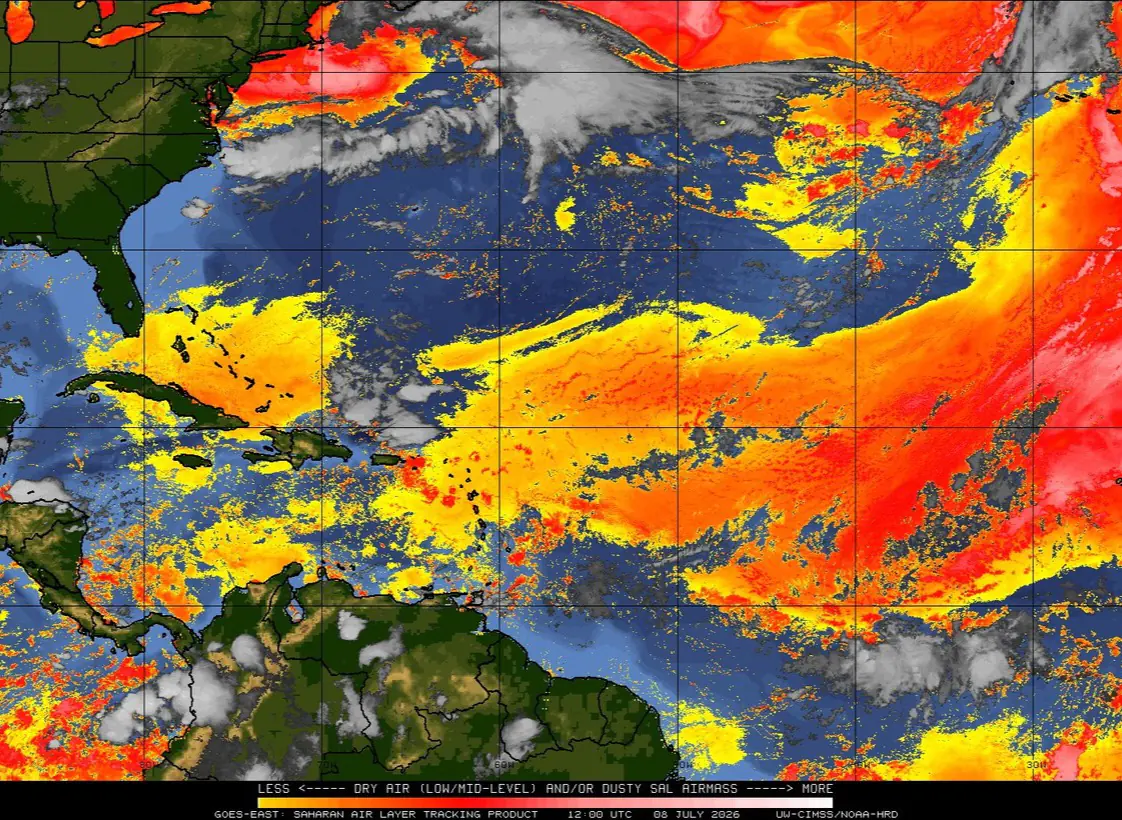
GOES-East Saharan Air Layer (SAL) tracking product valid July 8, 2026, at 12:00 UTC. The color scale shows the concentration of dry and dusty air originating from the Sahara Desert. Yellow to red areas indicate higher concentrations of Saharan dust spreading across the tropical Atlantic toward the Caribbean, Bahamas, and Florida.
MIAMI, Florida — On July 8, 2026, NOAA GOES-19 satellite imagery shows a massive Saharan dust plume crossing the Atlantic Ocean and engulfing the Caribbean, Florida, and the eastern Gulf of Mexico.
A significant plume of Saharan Dust is currently affecting South Florida‘s weather and air quality, resulting in hazy skies, reduced rain chances, and hotter-feeling conditions across the region.
This event is expected to temporarily suppress 2026 Atlantic hurricane and tropical storm formation while potentially triggering harmful algae blooms across the Sunshine State.
Because the dust particles are so small – often less than 0.002 mm across – they can remain aloft for days, carried by global air currents, forming what is known as the Saharan Air Layer (SAL).
Larger grains of sand don’t get airborne as often or for as long, but they can be pushed along the ground by the wind or eroded by water.
These Saharan dust plumes typically take 5 to 7 days to travel across the Atlantic, reaching the Caribbean and the Americas, as tracked by NOAA’s GOES satellite imagery.
NOAA researchers have linked Saharan dust storms, composed of tiny dust specks, to reduced Atlantic hurricane activity due to the dry air and increased wind shear they introduce.
Jason Dunion, a hurricane researcher at the NOAA Atlantic Oceanographic and Meteorological Laboratory’s Hurricane Research Division in Miami, Florida, and his team at the University of Wisconsin-Madison analyzed 25 years of satellite data prior to 2006.
They found that during periods of intense hurricane activity, large Saharan dust clouds blowing westward from the desert are relatively scarce.
In contrast, during years with fewer hurricanes, dust storms were more intense, spreading widely across the Atlantic and Caribbean Sea, as noted in NOAA’s research on the Saharan Air Layer.
Saharan dust clouds can also fuel harmful algae blooms in Florida, impacting marine life and human health.
A NASA study found that iron-rich Saharan sand triggered a red tide algae bloom off Florida’s coast.
The iron nourishes bacteria that produce nitrogen, enabling rapid growth of red tide algae, such as Karenia brevis.
The iron also gives Saharan dust its faint orange hue, often visible in hazy sunsets across affected regions.
Copyright 2023-2025 FloridaWord.com