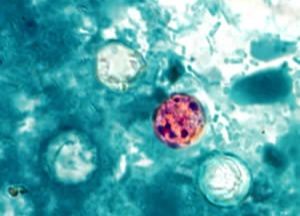
Oocysts of C. cayetanensis stained with modified acid-fast stain. Credit: U.S. Center for Disease Control
Health officials are tracking a sharp rise in cyclosporiasis infections across the United States this summer, with state reports showing the national total has climbed well beyond the 145 cases officially tallied by the CDC through mid-June.
The Centers for Disease Control and Prevention’s latest national surveillance update, released July 1, still lists 145 domestically acquired cases across 17 states as of June 16.
However, new data from state health departments reveal the outbreak has accelerated in July. Michigan has reported a major surge with hundreds of cases, Ohio has documented 177 cases, and Florida alone has confirmed 48 cases between June 1 and July 3.
According to the Florida Department of Health, there are reported cases in 24 counties. Here is the full list of confirmed cases by county:
| County | Cases |
|---|---|
| Lee | 8 |
| Broward | 5 |
| Miami-Dade | 5 |
| Orange | 3 |
| Collier | 2 |
| Hillsborough | 2 |
| Osceola | 2 |
| Polk | 2 |
| Seminole | 2 |
| St. Johns | 2 |
| Volusia | 2 |
| Alachua | 1 |
| Brevard | 1 |
| Columbia | 1 |
| Duval | 1 |
| Escambia | 1 |
| Flagler | 1 |
| Gadsden | 1 |
| Highlands | 1 |
| Lake | 1 |
| Palm Beach | 1 |
| Pasco | 1 |
| Pinellas | 1 |
| Sumter | 1 |
Total: 48 cases
Cyclosporiasis is an intestinal illness caused by the microscopic parasite Cyclospora cayetanensis. It spreads through the fecal-oral route when people consume food or water contaminated with the parasite’s eggs. It is not transmitted directly from person to person.
In the U.S., outbreaks are most commonly linked to fresh produce. Common vehicles include raspberries, blackberries, basil, cilantro, lettuce, mesclun mixes, and snow peas. Contamination can occur during growing, harvesting, or packaging — often through irrigation water or handling.
Symptoms typically begin about one week after exposure (ranging from 2 to 14 days). The hallmark is explosive, watery diarrhea that can persist for days or weeks without treatment. Other frequent symptoms include:
The illness can be prolonged and more severe in older adults, young children, and people with weakened immune systems.
If you experience prolonged watery diarrhea or other symptoms of cyclosporiasis, contact your healthcare provider for testing and treatment. The infection is treatable with antibiotics.
To reduce risk:
Copyright 2023-2025 FloridaWord.com