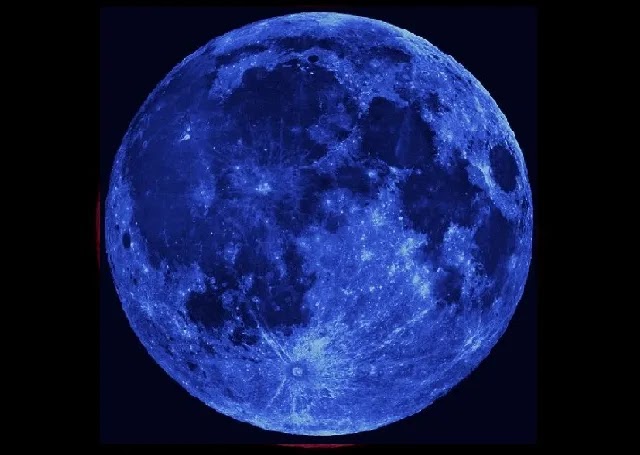
MIAMI, Florida – The May 2026 Full Moon is a Blue Moon and Micromoon that will occur on Sunday, May 31, 2026, beginning with a moonrise over Florida’s east coast at 7:52 p.m. Eastern Daylight Time on Saturday, May 30 (with a few minutes of variation depending on your exact location).
The Full Moon will technically reach peak fullness at 4:45 a.m. Eastern Daylight Time on May 31, according to the U.S. Naval Observatory.
Low hanging moons near the horizon appear larger to humans.
So, the Blue Micromoon will appear biggest to the naked eye on the U.S. east coast during and just after the moonrise around 7:52 p.m. Eastern Daylight Time on May 30.
According to NASA, the Moon follows an elliptical orbit around the Earth. When the Moon is at its farthest point (apogee), it is a Micromoon.
At its farthest point, the full moon can appear up to 14 percent smaller and 30 percent dimmer than a Supermoon (the closest full moon of the year).
A full moon at its farthest point from Earth will definitely be smaller and slightly less bright than average. But it won’t look dramatically different than a “normal” full moon and will not have any readily observable effect on our planet except perhaps slightly higher tides.
Blue Moons occur when there is a second full moon in a calendar month or when a season has four full moons.
Full moons are separated by 29.5 days but seasons are 88 to 92 days long – so it is possible to fit four full moons into a single season. This happens just over two-and-a-half years, on average.
When there are four full moons in a season, the third full moon is considered a Blue Moon.
This is why the phrase “Once in a Blue Moon” is commonly known to mean something rare and offbeat because of the rare occurrence of a Blue Moon.
The date of a full moon doesn’t affect the full moon’s color. The Full Moon on Sunday, May 31, 2026, will appear pearly-gray to most locations on Earth.
According to NASA, the key to a moon appearing blue is to have lots of particles slightly wider than the wavelength of red light (0.7 micron) and no other sizes present in the air. This is rare, but volcanoes sometimes produce such clouds, as do forest fires.
Humans saw blue moons almost every night when the Krakatoa volcano exploded in 1883 with the force of a 100-megaton nuclear bomb. Plumes of ash rose to the very top of Earth’s atmosphere.
Some of those ash-clouds were filled with particles about 1 micron wide – just the right size to strongly scatter red light while allowing other colors to pass.
White moonbeams shining through the clouds emerged blue, and sometimes green.
People also saw blue-colored Moons in 1983 after the eruption of the El Chichon volcano in Mexico. And there are reports of blue Moons caused by Mt. St. Helens in 1980 and Mount Pinatubo in 1991.
A Flower Moon. Native American tribes named the May full moon this because of the abundant flowers blooming in spring, according to the Farmer’s Almanac. Note that the first Flower Moon occurred on May 1, 2026, while May 31 is the second full moon — the Blue Micromoon.
For those planning to walk, bike, or run along the beach in Florida, this Full Moon brings along with it higher-than-average Atlantic Ocean high tides on the east coast and elevated tides on Florida’s Gulf Coast (spring tides occur around full and new moons).
Copyright 2023-2025 FloridaWord.com