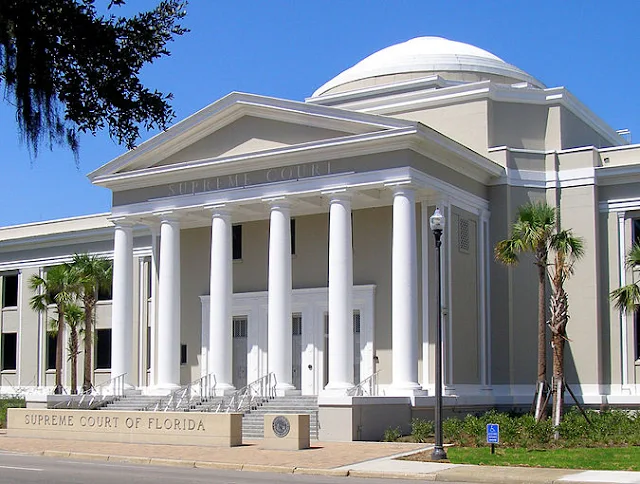
TALLAHASSEE, FL – In a Thursday opinion, the Florida Supreme Court amended its bar admission rules to allow graduates from law schools accredited by any U.S. Department of Education-recognized body, not just the ABA. The change, effective October 1, 2026, aims to promote high-quality, affordable legal education and competition, following a court review that found the ABA monopoly no longer best serves Floridians. Five justices backed the move, citing goals like nondiscrimination, while one dissented over risks to rigorous standards; it echoes Texas’s recent step.
“This is a good start. The ABA is a captured, far-left organization and should not dictate the ability of Florida students to sit for the Bar,” Florida Attorney General James Uthmeier posted on X.
The amended rule defines “accredited law school” as one approved or provisionally approved by a programmatic accrediting agency recognized by the U.S. Department of Education for legal education programs or by an institutional accrediting agency recognized by the department and additionally approved by the court. Currently, the ABA is the only such programmatic accreditor. The court may impose additional requirements on institutional accreditors, such as standards for curriculum, bar passage rates, and academic freedom protections.
“Good move. The (highly partisan) ABA should not be a gatekeeper for legal education or the legal profession,” Florida Governor Ron DeSantis posted on X.
The amendments become effective on October 1, 2026, at 12:01 a.m., with a 75-day period for public comments ending March 31, 2026. Graduates of ABA-accredited law schools remain eligible, and law schools are not precluded from seeking ABA accreditation.
The decision follows the establishment of the Workgroup on the Role of the American Bar Association in Bar Admission Requirements in March 2025, chaired by former Justice Ricky Polston. The workgroup included members such as Dean Erin O’Hara O’Connor of Florida State University College of Law, Professor John F. Stinneford of the University of Florida Levin College of Law, and U.S. District Judge Allen C. Winsor. The workgroup submitted its final report on October 27, 2025, identifying 12 potential alternatives to reliance on the ABA.
The workgroup was directed to evaluate the rules’ reliance on the ABA, which dates back to 1955 and became exclusive in 1992, amid concerns about ABA accreditation standards on diversity, equity, and inclusion (DEI) policies, political engagement, law school costs, and innovation. Chief Justice Carlos Muñiz stated: “We are open minded, we realize there are a lot of moving parts to this issue, and ultimately we’ll try to do what’s best for the people of our State.”
Florida has 12 ABA-accredited law schools, which produced the majority of the 2,890 first-time bar exam takers in 2024. Alternative pathways for non-ABA graduates were used by only 10 applicants that year. The Florida Bar has over 115,000 members, making it the third-largest state bar association in the nation.
Justice Jorge Labarga dissented, arguing that the ABA’s role since 1992 has ensured rigorous standards in areas such as financial resources, academic support, and bar passage rates. He stated that replacing the ABA with unknown alternatives is detrimental.
The court expressed support for additional programmatic accreditors and intends to contact institutional accreditors to assess interest in accrediting law schools.
Copyright 2023-2025 FloridaWord.com