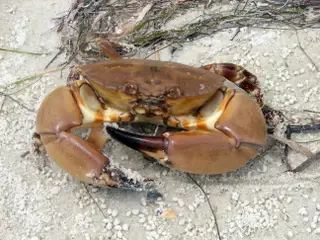
Florida stone crab. Credit: FWC
FORT MYERS, Florida – Florida’s recreational and commercial stone crab claw harvest season opens October 15 in state and federal waters. To be harvested, stone crab claws must be at least 2 7/8 inches in length when measured from the elbow to the tip of the lower immovable portion of the claw (see illustration), according to the Florida Fish and Wildlife Conservation Commission.
View a video on how to properly remove the claw on the FWC YouTube channel and increase the chance the crabs you release will survive.
Harvesters are encouraged to take only one claw, even if both claws are of legal size, so the released crab will be better able to defend itself from predators.
A crab that is returned to the water with one claw intact will be able to obtain more food in a shorter amount of time and therefore regrow its claw faster.
There is a recreational daily bag limit of 1 gallon of claws per person or 2 gallons per vessel, whichever is less.
Claws may not be taken from egg-bearing stone crabs. Stone crabs may not be harvested with any device that can puncture, crush or injure a crab’s body. Examples of devices that can cause this kind of damage include spears and hooks.
Recreational harvesters age 16 and older are required to complete an online, no-cost recreational stone crab trap registration before using up to five stone crab traps per person. Recreational and commercial traps may be baited and placed in the water October 5, but claws cannot be harvested or possessed until October 15.
Traps that are not being fished should be removed from the water to avoid ghost fishing, a process in which marine species get caught in the trap for extended periods of time and are not harvested.
The season will be open through May 1, 2026, closing May 2.
Stone crab regulations are the same in state and federal waters.
Copyright 2023-2025 FloridaWord.com